

Interlaced
Interlaced is a video scanning method that splits each frame into two fields, displaying alternating horizontal lines. It transmits odd-numbered lines, then even-numbered ones, creating a complete image when viewed in rapid succession such as 50 or 60 (fps). By only sending half of the picture's information per field, interlacing reduces transmission bandwidth by nearly 50% compared to sending a full frame at once.
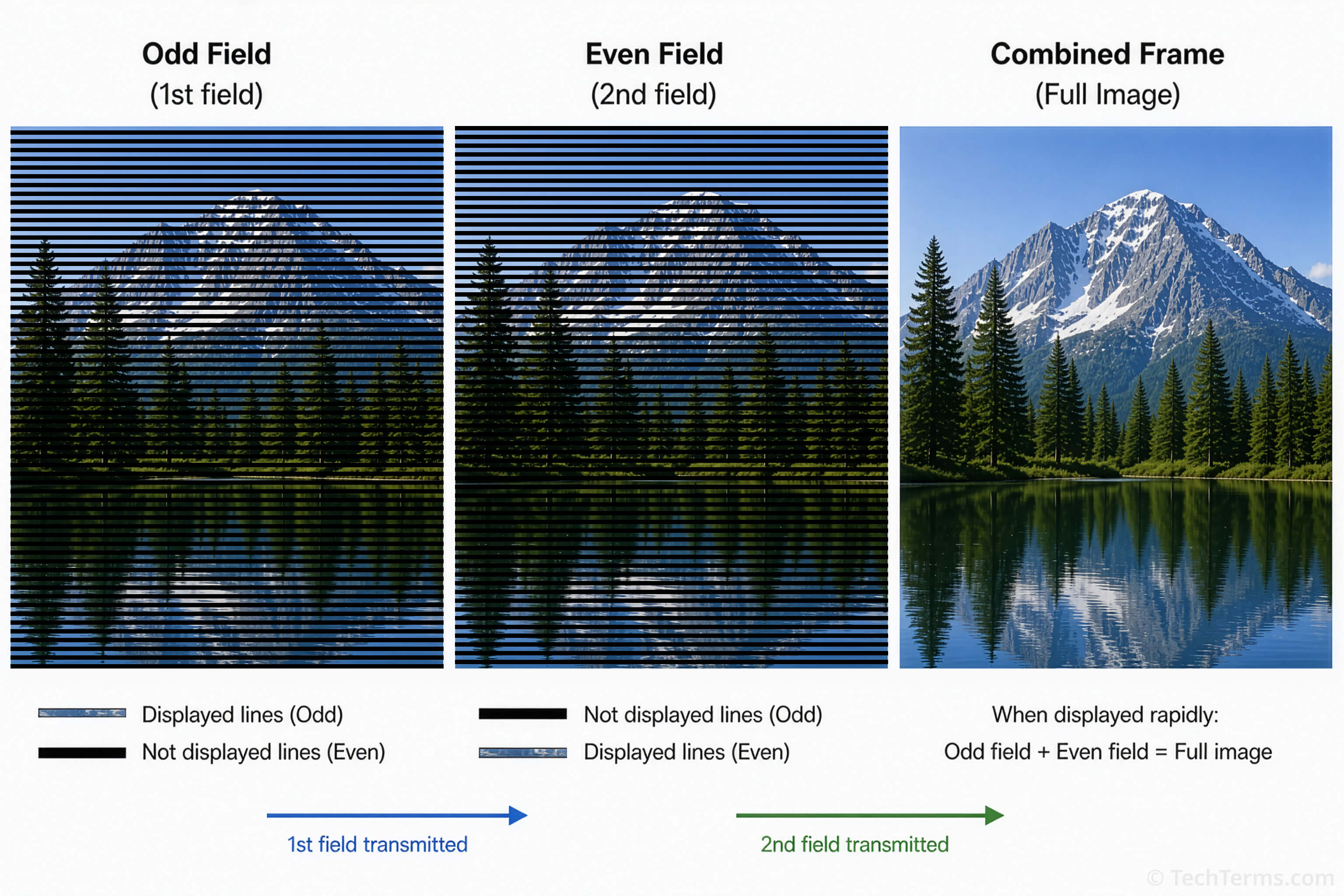
While interlacing is not noticeable to the human eye with static or slow-moving images, it can introduce visual artifacts during fast motion, common in sports and video games. These may include flickering, blurring, or "combing" effects where moving objects appear split between fields. Therefore, modern video systems commonly use progressive scan, producing a clearer and more stable image, particularly on LCD and OLED screens.
History
Interlacing was introduced with analog television formats such as NTSC in North America and PAL in Europe. This approach was especially important in early broadcast systems, where bandwidth was limited.
HDTV and 4K
HDTV standards came in three primary versions:
- 720p - 1280x720 resolution with progressive scan
- 1080i - 1920×1080 resolution with interlaced output
- 1080p - 1920×1080 resolution with progressive scan
4K movies and shows are typically broadcast in 2160p, which has a resolution of 3840x2160 with progressive scan. There is no interlaced 4K standard.
 Test Your Knowledge